RBI Digital Accessibility Compliance Guide for Banks and NBFCs (2025–2026)
A simple, point-wise guide to the RBI’s digital accessibility mandate – what the Supreme Court ordered, what the RBI now requires, and exactly how banks, NBFCs, and other regulated entities can comply.
If you work at a bank, NBFC, payment bank, or any RBI-regulated entity, here’s the headline: digital accessibility is no longer a “good practice.” After a Supreme Court judgment and an RBI circular, it’s a compliance requirement – and the RBI has asked for immediate action.
This guide breaks down what happened, who it applies to, what you actually have to do, and how to get your KYC, apps, and websites compliant – without drowning in legalese.
What is the RBI’s digital accessibility mandate?
In plain terms: the RBI now requires every regulated entity to make its digital services — websites, mobile apps, KYC processes, ATMs, and more – usable by persons with disabilities, including people with blindness or low vision and acid attack survivors.
A quick rundown of how we got here:
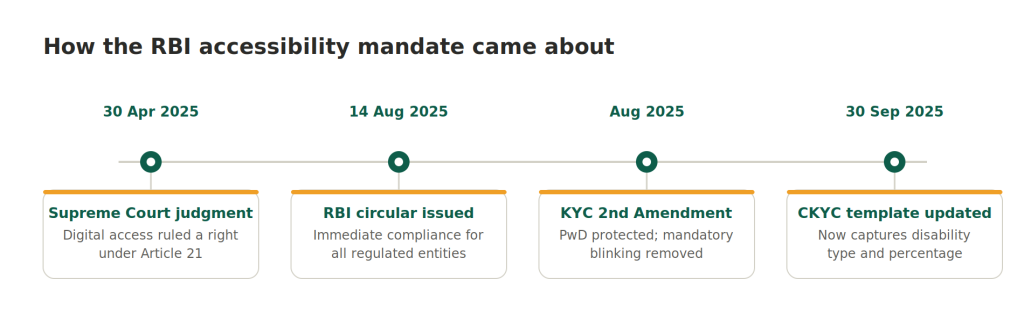
- It started with a Supreme Court judgment on April 30, 2025 in Pragya Prasun & Ors. v. Union of India and Amar Jain v. Union of India. The Court held that digital access is part of the right to life under Article 21 of the Constitution.
- The case was sparked by real exclusion — for example, a petitioner who couldn’t open a bank account because she couldn’t perform the “blinking” required for liveness verification.
- The Court issued 20 directions to regulators and regulated entities to fix this.
- The RBI then issued a compliance circular on August 14, 2025 (RBI/2025-26/75) to all regulated entities, asking for immediate compliance.
- The RBI also amended its KYC rulebook through the KYC (2nd Amendment) Directions, 2025.
This isn’t symbolic. India has over 26 million persons with disabilities (Census figures), and when account opening, KYC, and banking happen mostly online, inaccessible systems lock these people out of basic financial life. That’s the gap the RBI is closing.
Who needs to comply?
If you’re an RBI-regulated entity (RE) with customer-facing digital services, this applies to you. That includes:
- Commercial banks
- Cooperative banks
- Small finance banks and payment banks
- Non-Banking Financial Companies (NBFCs)
- Financial Institutions (FIs)
- Other financial service providers regulated by the RBI
In short: if a customer interacts with you through a website, app, video KYC, or ATM, you’re in scope.
What the Supreme Court actually told banks and NBFCs to do
Most of the 20 directions were aimed at regulators, but several land directly on banks and NBFCs. The key ones:
- Run periodic accessibility audits by certified professionals — and involve persons with disabilities in user testing of your apps and websites.
- Build to the BIS accessibility standard (IS 17802:2022). This covers your websites and web apps, mobile apps, KYC/e-KYC/video-KYC modules, digital documents and e-forms, and hardware touchpoints like ATMs and self-service machines.
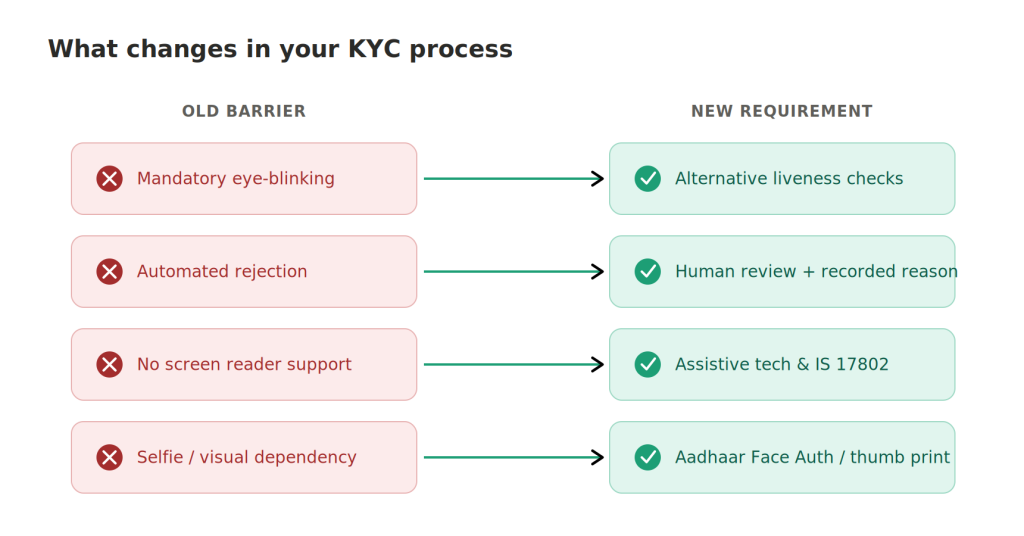
- Stop auto-rejecting applications from persons with disabilities. You can’t reject without proper human consideration, and you must record the reasons. The RBI now expects a designated officer empowered to override automated rejections and approve case by case.
- Accept Aadhaar Face Authentication as a valid method during customer due diligence.
- Fix liveness checks. During video KYC, you can’t rely solely on eye-blinking. Officials can ask varied questions to confirm liveness instead, so the process doesn’t exclude people who physically can’t blink on cue.
What changed in the RBI’s KYC rules
The KYC (2nd Amendment) Directions, 2025 baked these protections into the Master Direction on KYC. The practical changes:
- Persons with disabilities are now a specifically protected class in the KYC framework.
- No mandatory blinking for liveness in video KYC; alternative verification is allowed.
- Aadhaar Face Authentication and thumb impressions are accepted as biometric alternatives.
- Rejections must be justified, documented, and humanly reviewed — not left to an automated checkbox.
- The CKYC Registry (CERSAI) updated its KYC template (live from September 30, 2025) to capture disability type and percentage, so this data is formally recorded.
Your phase-by-phase compliance roadmap
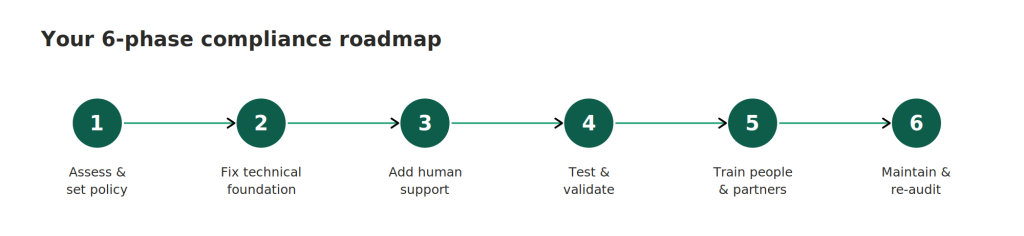
The RBI’s expectation is “immediate compliance,” but the work is best done in stages. Here’s a practical roadmap based on the Supreme Court directions and RBI notification:
Phase 1 — Assess and set policy
- Inventory every customer-facing platform: websites, apps, KYC systems.
- Document current accessibility barriers and flag high-risk areas.
- Update your KYC policy and SOPs to include disability-inclusive protocols and accessible paper-based KYC options.
Phase 2 — Fix the technical foundation
- Add alternative liveness detection (gesture-based, facial movement, or audio-based) and remove mandatory blinking.
- Accept thumb impressions and Aadhaar Face Authentication for biometric KYC.
- Make all digital platforms meet IS 17802:2022 and integrate assistive tech support (screen reader compatibility, voice navigation).
- Add disability fields to your KYC templates and database for better service.
Phase 3 — Add human support
- Set up a dedicated PwD helpline offering step-by-step KYC help by voice or video.
- Run staff sensitisation and disability-awareness training across branches.
- Allow nominated guardians or family to assist, and provide certified sign-language interpreters over video where needed.
- Offer doorstep authentication for severely disabled applicants (without causing them discomfort).
Phase 4 — Test and validate
- Test the full customer journey with persons across visual, hearing, physical, and cognitive disabilities.
- Engage an IAAP-certified professional to conduct the accessibility audit.
- Security-test your alternative authentication methods.
Phase 5 — Train your people and partners
- Build training modules on disability awareness, alternative KYC, and assistive tech.
- Make sure Business Correspondents, agents, and tech vendors understand the accessibility requirements too.
Phase 6 — Keep it going
- Decide your audit frequency and stick to a regular schedule.
- Submit compliance status and implementation plans to the RBI as and when required.
The standards and laws behind all this
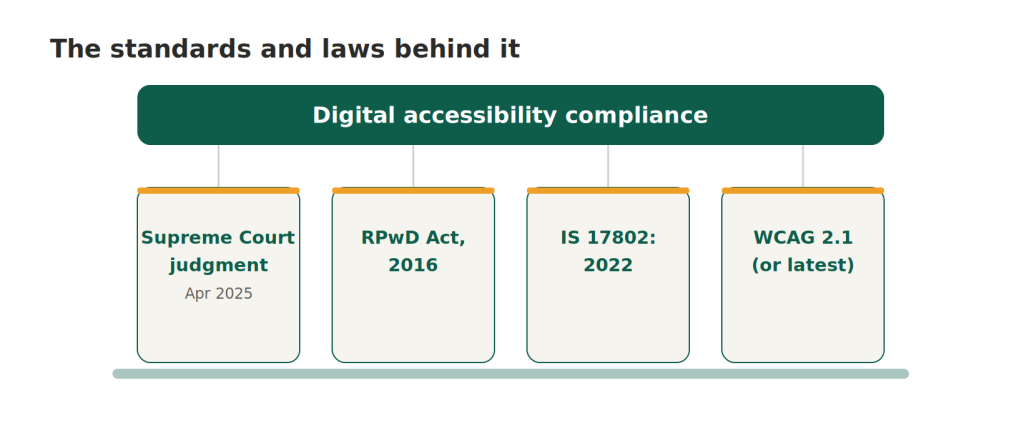
You don’t have to invent your own rulebook. The framework rests on:
- IS 17802:2022 — the Bureau of Indian Standards’ accessibility standard for ICT products and services. This is the RBI’s core technical benchmark.
- WCAG 2.1 (or latest) — the global W3C standard built on four principles: Perceivable, Operable, Understandable, Robust.
- RPwD Act, 2016 — especially Section 3 (equality and non-discrimination), Section 40 (accessibility standards), and Section 46 (time-bound compliance by service providers).
- The Supreme Court judgment (April 30, 2025) — which makes all of the above a constitutional obligation, not just a regulatory one.
Get your IAAP audit done — DIGISARAL can help
A recurring requirement across both the RBI and SEBI frameworks is the same: your accessibility audit must be conducted by an IAAP-certified professional, and it should include usability testing by persons with disabilities. This isn’t a self-assessment you can tick off internally.
DIGISARAL conducts IAAP audits for both SEBI-regulated and RBI-regulated entities. If you’re a bank, NBFC, broker, AMC, or any other regulated entity working toward compliance, DIGISARAL can audit your websites, mobile apps, KYC flows, and digital documents against IS 17802, WCAG, and the regulators’ requirements — and guide you through remediation so you actually close the gaps, not just identify them.
Whether you fall under the RBI’s August 2025 circular or SEBI’s accessibility circulars, a certified audit is the step that turns a compliance obligation into a verified, defensible position.
Why this matters (beyond avoiding penalties)
It’s tempting to treat this as paperwork. It isn’t:
- It’s a constitutional obligation now. The Supreme Court tied digital access to Article 21 — this carries real legal weight.
- It expands your customer base. Accessible banking reaches millions of people with disabilities, plus older customers and anyone using assistive tech.
- It’s better design for everyone. Clear navigation, flexible KYC, and well-structured documents improve the experience for all customers.
- It reduces risk. Documented, human-reviewed processes protect you from discrimination claims and regulatory scrutiny.
Quick FAQ
Is digital accessibility mandatory for banks and NBFCs? Yes. Following the April 30, 2025 Supreme Court judgment and the RBI’s August 14, 2025 circular (RBI/2025-26/75), it’s a compliance requirement, and the RBI has called for immediate compliance.
Can we still use eye-blinking for video KYC liveness? Not as the only method. You must offer alternatives so people who can’t blink on cue aren’t excluded.
Can we reject a KYC application because the customer has a disability? No. Rejections need human review and documented reasons, and you should have a designated officer who can override automated rejections.
Which technical standard should we build to? IS 17802:2022 is the RBI’s core ICT accessibility standard, alongside WCAG 2.1. Both support the RPwD Act’s requirements.
Who can do our accessibility audit? An IAAP-certified accessibility professional, with usability testing by persons with disabilities. DIGISARAL (digisaral.com) provides this for both RBI and SEBI regulated entities.
Final word
The RBI’s message is direct: every customer, regardless of ability, should be able to bank with you independently. The compliance clock is already running, so the smart move is to inventory your platforms, fix the obvious KYC barriers, and line up a certified IAAP audit now — rather than waiting for a regulator or a complaint to force the issue.
Accessibility done right isn’t just compliance. It’s a wider, fairer, more durable banking franchise.
This guide is based on the Supreme Court of India judgment dated April 30, 2025, the RBI circular dated August 14, 2025 (RBI/2025-26/75), and the RBI KYC (2nd Amendment) Directions, 2025. For specific compliance decisions, refer to the official notifications on rbi.org.in or consult a qualified accessibility and legal advisor. This is general information, not legal advice.